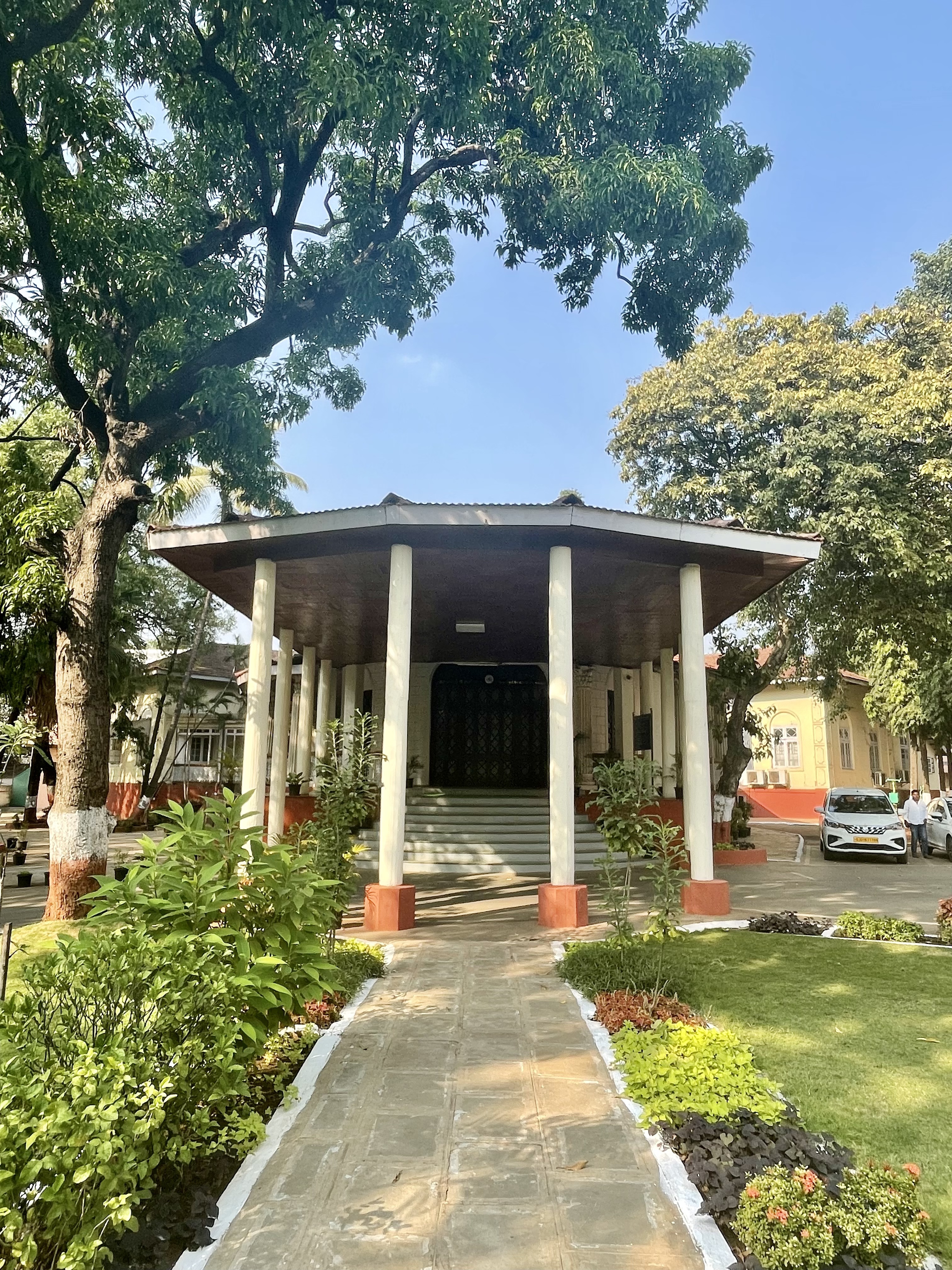
The story of a quiet station on the Pune–Satara line that once stood at the beginning of the journey to one of the Bombay Presidency’s most celebrated hill stations.

My first impression of Wathar station was quite strange. When I joined Pune Division in 2022 I was travelling in the Pune-Satara section for understanding the section and suddenly I was awestruck by the beauty of a small station which appeared out of nowhere. When I enquired about the station and its history there were many stories among the staff but no one was quite sure as to why and how this beautiful railway station came into existence. This is the reason that I decided to write this article.
Today, Wathar is a relatively quiet station on the Pune–Satara section of Central Railway. To the casual traveller, it may appear to be just another small station on the line. Yet its historic building tells a very different story.
For several decades in the late nineteenth and early twentieth centuries, Wathar was the railway gateway to Mahabaleshwar.
Long before the motor car transformed travel in the Western Ghats, the journey to Mahabaleshwar involved a change of worlds. The traveller first travelled by railway across the Deccan plateau, alighting at Wathar. From there, the railway journey ended and the road journey to the hills began—through Wai and Panchgani, and finally upwards into Mahabaleshwar.
Wathar was therefore much more than a stopping place. It was the point at which railway travel became a journey into the hills. And the history of Wathar station is inseparable from that role.
The railway reaches Wathar
Wathar became part of the railway network during the expansion of the Southern Mahratta Railway (SMR) in the 1880s. The railway through the Satara region formed part of the SMR’s metre-gauge system connecting Pune with the south. Contemporary records list Wathar among the stations on the line, alongside Lonand, Salpa, Adarki, Palshi, Satara Road, Koregaon, Rahimatpur and others. The railway’s arrival fundamentally altered the geography of travel in the region. For Mahabaleshwar, however, the railway could not climb into the hills. The final portion of the journey remained a road journey. Wathar consequently acquired an importance that its size alone would never suggest.
It became the railhead for Mahabaleshwar.
Wathar and the road to the hills
The connection between Wathar and Mahabaleshwar was not merely an informal arrangement that developed among travellers. A dedicated road connection was developed between Wathar and Wai, from where the route continued towards Panchgani and Mahabaleshwar. The road was completed during 1887–88, at a reported expenditure of ₹1,27,362—a considerable investment at the time.
The railway and the road therefore formed a single transport system:
Pune → Wathar by railway → Wai by road → Panchgani → Mahabaleshwar
For the traveller of the late nineteenth century, this was the established route to the hills.
A traveller’s Wathar: 14 November 1888
Perhaps the most evocative evidence for Wathar’s importance comes not from a railway report, but from the memoir of an aristocratic European traveller.
In November 1888, Margaret Elizabeth Leigh Child-Villiers, Countess of Jersey, travelled to Mahabaleshwar with her party to stay with Lord and Lady Reay, the Governor of Bombay. Her account records a remarkably simple sentence: “We left the train at Wathar.”
From Wathar, the party continued by road for approximately five hours to Mahabaleshwar, arriving later that evening. The sentence is easy to overlook. But historically it is extraordinarily valuable.
It gives us a first-hand European account placing Wathar firmly within the Mahabaleshwar travel route only a few years after the railway had reached the region.
Wathar was built around the Mahabaleshwar season
As Mahabaleshwar grew in popularity as a summer retreat, the importance of Wathar increased. The railway administration eventually had to respond to the seasonal influx of passengers. The 1895–96 Railway Administration Report records the completion of: “additional waiting accommodation for 1st and 2nd class passengers at Wathar to cope with the Mahableshwar season traffic.”
This is one of the most important pieces of evidence in the history of the station. It tells us two things.
First, Wathar already possessed passenger accommodation before 1895–96—the railway was adding to it rather than constructing a station from scratch.
Second, the reason for the expenditure is explicitly recorded: Mahabaleshwar season traffic.
The architecture and facilities of Wathar were therefore being shaped by the demands of the hill station nearly forty miles away.
The Maharashtra Gazetteer records the later station as having upper-class waiting rooms and vegetarian and non-vegetarian refreshment facilities, and specifically notes that Wathar served the tourist traffic to Mahabaleshwar. Wathar had become a tourist station without ever becoming a large urban station. Its importance came from where it led.
A European traveller’s journey in the 1890s
The role of Wathar was not confined to Indian railway records. European travel literature repeatedly describes the same journey.
F. H. S. Merewether, writing of his travels through western India during the famine of 1896–97, specifically identifies Wathar as the station where travellers disembarked when travelling to the hill station of Mahabaleshwar.
His account is particularly valuable because it is a first-hand description from the very period when Wathar’s passenger facilities had recently been expanded.
Other European travel accounts describe the onward journey from Wathar through Wai and Panchgani, with carriages arranged for the final journey to Mahabaleshwar.
Thus, in the travel literature of the period, the name of Wathar repeatedly appears not as an isolated railway station, but as part of a familiar route:
Wathar — Wai — Panchgani — Mahabaleshwar.
The station at the beginning of the mountain journey
There must have been something rather distinctive about arriving at Wathar in those years. The railway traveller had spent hours crossing the Deccan by the comparatively new technology of the railway. At Wathar, the character of the journey changed. Luggage was transferred. Carriages and tongas waited. The railway refreshment facilities catered to travellers. And the road journey began.
From Wathar the traveller proceeded towards Wai, crossed the Krishna valley and then began the ascent towards Panchgani and Mahabaleshwar.
For a visitor arriving from Bombay, Wathar was therefore the threshold between two landscapes: the railway landscape of the Deccan and the mountain landscape of the Western Ghats.
This is perhaps the best way to understand the historical importance of Wathar.
From tourist gateway to controlled gateway
The importance of Wathar increased further at the end of the nineteenth century.
During the plague epidemic, arrangements were made for the inspection of passengers arriving at Wathar before they proceeded towards Wai, Panchgani and Mahabaleshwar. The station had by then become more than a transport interchange. It was a controlled gateway into the hill-station region.
In a remarkably short period, Wathar had evolved from a newly established railway station into an important interface between:
- the railway,
- the road network,
- the tourist economy,
- the hill stations,
- and public-health administration.
What did the original Wathar station look like?
Wathar is today recognised in the Indian Railways Heritage Inventory as a heritage railway station in Pune Division. The inventory, however, does not give a construction date for the station building.
Through my research it has been established that a passenger station was certainly functioning by 1888. We also know that additional first- and second-class passenger accommodation was added in 1895–96.
But we have not yet located a surviving primary document that says:
“The present Wathar station building was constructed in [year].”
Nor have we found an authenticated photograph of the station from the 1880s or 1890s. Consequently, it would be premature to assign the entire surviving structure a precise construction date. The surviving building may preserve the physical memory of these successive phases of development.
The long platform elevation, tiled roof, repeated gables, verandah and arched openings visible in photographs taken before the recent redevelopment give Wathar an architectural character quite different from that of a purely utilitarian halt.
The 2004 photographs provide our earliest located photographic record of the building, while a detailed photograph from 8 August 2023 records the station immediately before the latest redevelopment. The fundamental form of the building appears substantially unchanged between these records.
The question of which portions belong to the original 1880s station and which may relate to the 1895–96 expansion remains open—and is precisely what makes Wathar an interesting subject for further heritage research.
Wathar through the years: A timeline of a railway gateway
1880s — The Southern Mahratta Railway expands through the Satara region and Wathar becomes part of the railway network.
1887–88 — The Wathar–Wai feeder road is completed, strengthening the rail-to-road connection towards Mahabaleshwar.
14 November 1888 — The Countess of Jersey records leaving the train at Wathar before continuing by carriage to Mahabaleshwar.
1890s — Wathar becomes firmly established as the railway gateway for Mahabaleshwar’s growing seasonal traffic.
1895–96 — Additional first- and second-class waiting accommodation is completed at Wathar specifically to cope with Mahabaleshwar season traffic.
1896–97 — F. H. S. Merewether travels through Wathar and identifies it as the station for travellers proceeding to Mahabaleshwar.
1898 — Merewether’s illustrated account of his travels is published.
1899 — Wathar becomes a point of passenger inspection during plague-control arrangements for travellers proceeding towards Wai, Panchgani and Mahabaleshwar.
Early 1900s — European travel literature continues to describe Wathar as the railhead for the journey to Mahabaleshwar.
1911 — Contemporary reference works still identify Wathar as the railway station from which Mahabaleshwar was reached by carriage.
20th century — The railway’s role as Mahabaleshwar’s principal gateway gradually diminishes as road transport improves.
24 July 2004 — One of the earliest located photographs records the surviving historic station building.
8 August 2023 — A high-resolution photograph documents the historic building immediately before its latest redevelopment.
2020s — Wathar is included in the Indian Railways Heritage Inventory and is being redeveloped under the Amrit Bharat Station Scheme.
The end of the railway’s role as Mahabaleshwar’s gateway
The very thing that had made Wathar important eventually made it less important. In the nineteenth century, the railway could bring the traveller only as far as Wathar. The remaining journey had to be made by carriage.
As roads improved and motor vehicles became increasingly common, the journey to Mahabaleshwar no longer depended upon a railway-to-carriage interchange at Wathar. The geography of travel changed. Mahabaleshwar could increasingly be approached directly by road. The old relationship between: Wathar → Wai → Panchgani → Mahabaleshwar gradually ceased to be the defining route to the hills. Wathar remained a railway station, but its special historical role as the gateway to Mahabaleshwar faded.
A heritage station entering a new era
Today Wathar finds itself at another turning point. It has been included in the Amrit Bharat Station Scheme, the Indian Railways programme for the redevelopment and modernisation of selected stations. Wathar appears in the official Maharashtra list of stations selected under the scheme.
The redevelopment brings new facilities and a new visual identity to a station whose history reaches back to the early years of the Southern Mahratta Railway.
This creates an interesting moment in the station’s history.
The Wathar that served Victorian travellers on their way to Mahabaleshwar is disappearing further into the past. But the historic station building also reminds us that railway heritage is not always about the largest stations, grandest terminals or busiest junctions. Sometimes the significance of a station lies in what passed through it, who used it, and where the railway journey ended.
Wathar and the world of cinema
Wathar has acquired another, very different identity in recent decades—as one of Central Railway’s recognised film-shooting locations. Its old railway architecture, relatively quiet surroundings and rural landscape have made the station particularly attractive to filmmakers looking for an authentic period or countryside setting.
Central Railway’s own list of identified shooting locations records productions including Pune 52, Gori Tere Pyaar Mein, Zilla Ghaziabad, Gunday and Jigariyaa as having used Wathar. Among these, Gunday provides perhaps the most striking example: two elaborate train-action sequences featuring Ranveer Singh and Arjun Kapoor were shot at Wathar, which was used to recreate the atmosphere of an earlier era and the world of coal trains.
Wathar’s cinematic association continued with films such as Dabangg 3; in 2019–20, Central Railway earned ₹37.22 lakh from three film shoots at Wathar, with Dabangg 3 alone contributing ₹15.70 lakh. Thus, the station has acquired an intriguing second life: once it was the place where travellers left the railway to begin their journey towards Mahabaleshwar; today, it is itself a destination for filmmakers seeking the atmosphere of an older India.
More than a station
Wathar’s history is ultimately a story about connectivity. The railway connected Bombay and Pune with the Deccan interior. The road connected Wathar with Wai. Wai connected the traveller to Panchgani and Panchgani led into Mahabaleshwar.
For the European visitor of the late nineteenth century, Wathar was the moment when the railway carriage gave way to the horse-drawn carriage, when the level Deccan began to give way to the mountains, and when an ordinary railway journey became a journey to a celebrated hill station.
That is why the modest heritage building at Wathar deserves to be remembered. It was once the beginning of the Mahabaleshwar journey. For several decades, for travellers arriving by rail, Mahabaleshwar began at Wathar.
A note on the building’s date
One question remains deliberately open. Our research has established that:
- Wathar was already functioning as a passenger station by November 1888;
- the station was serving Mahabaleshwar-bound travellers;
- additional first- and second-class waiting accommodation was completed in 1895–96 specifically for the Mahabaleshwar season;
- the surviving building is recognised by Indian Railways as a heritage structure.
However, no primary source located so far gives an exact construction date for the present station building.
Sources and References
- Bombay Presidency Gazetteer – Satara District, Railways
https://gazetteers.maharashtra.gov.in/cultural.maharashtra.gov.in/english/gazetteer/SATARA/comm_railways.html - Margaret, Countess of Jersey, Fifty-One Years of Victorian Life (1922) – account of her 1888 journey to Mahabaleshwar
https://www.gutenberg.org/files/38569/38569-h/38569-h.htm - Dattatraya Kamalakar Dixit, Mahabaleshwar (1902) – digitised Marathi edition
https://mr.wikisource.org/wiki/महाबळेश्वर - Railway Administration Report, Bombay Presidency, 1895–96 – record of additional first- and second-class waiting accommodation at Wathar for Mahabaleshwar season traffic
https://dspace.gipe.ac.in/xmlui/bitstream/handle/10973/18165/GIPE-015980.pdf?isAllowed=y&sequence=3 - Indian Railways Heritage Inventory – Wathar Railway Station, Pune Division
https://st.indiarailinfo.com/kjfdsuiemjvcya23/0/4/4/7/4985447/0/2buildingandstations223586.pdf - Indian Railways / PIB – Amrit Bharat Station Scheme, Maharashtra
https://www.pib.gov.in/Pressreleaseshare.aspx?PRID=1983976&lang=2®=48 - India Rail Info – Wathar Station photographic/timeline records
https://d.indiarailinfo.com/station/timeline/edits-wathar-wtr/2235