There is a moment in the history of Indian railways that deserves to be remembered not merely as an achievement of engineering, but as a moment of arrival. On 14 June 1858, the railway reached Poona.
The journey had not been easy. From Bombay, the Great Indian Peninsula Railway had pushed steadily eastwards, across the coastal plain and towards the formidable barrier of the Western Ghats. The great Bhor Ghat crossing was still unfinished; the final railway connection across the Ghats would take another five years. Yet on the Deccan side of the unfinished Ghat, the railway had already reached the city. And before the railway could enter Poona, it had to cross the rivers.
Two great masonry structures dominated the final approach: the Dapoorie Viaduct over the Mula and the railway bridge over the Mutha, today known as the Old Sangam Railway Bridge.
The contemporary Bombay Government report for 1856–57 described the two large viaducts on this section as “the most important works on this Section” and recorded that they were approaching completion. The bridge at Sangam was therefore not an incidental crossing. It was one of the structures that made the railway’s arrival at Poona possible.
A railway approaching Poona
The work belonged to Contract No. 8 of the Great Indian Peninsula Railway, the section from Khandala to Poona. William Frederick Faviell had undertaken the work extending from the Bhor Ghat towards Poona. Contemporary accounts describe this continuation as involving substantial masonry and several large viaducts.
By 1856–57, the railway authorities were sufficiently confident of progress to expect the Khandala–Poona section to be ready for traffic in 1858. The Government report recorded that the earthworks were substantially complete, the permanent way and ballasting were advancing, and the two major viaducts were nearing completion.
The following year’s report records the decisive moment:
14 June 1858 — the section from Khandala to Poona was opened to public traffic.
There is an important distinction here. The railway had reached Poona in 1858, but the railway had not yet conquered the Bhor Ghat itself. For another five years, the difficult section between Khandala and Palasdhari remained an interruption in the through Bombay–Poona railway. The Sangam bridge, however, had already begun its long life.
The bridge at the Mutha
The structure that survives today is often confused with the nearby Wellesley or Sangam road bridge. They are not the same bridge.
The Wellesley Bridge stood at the Sangam and was a road crossing. The Bombay Presidency Gazetteer later described the railway structures separately, noting the new railway bridge and, above it, the old railway bridge, which had subsequently been converted to vehicular traffic.
The bridge we know today as the Old Sangam Bridge was originally a railway bridge across the Mutha. It was built around 1857 specifically for the Great Indian Peninsula Railway and remained in railway service for nearly seventy years.
Its exact original dimensions have proved surprisingly difficult to establish. Modern heritage documentation gives the surviving structure at approximately 250 metres in length and about 10 metres in width, but these figures relate to the present bridge, which has undergone subsequent modifications and widening. They should therefore not automatically be treated as the dimensions of the original 1857 railway structure.
Likewise, despite extensive searching, no reliable nineteenth-century source has yet been found giving the exact original number of arches or their individual spans. Rather than repeat figures that may actually belong to the neighbouring Wellesley Bridge, it is safer to leave these details open until the original engineering records are found.
A photograph without a name
Perhaps the most evocative evidence of the bridge’s early existence comes from the work of William Johnson, one of the pioneering photographers of nineteenth-century western India.
Johnson’s Photographs of Western India, preserved in the DeGolyer Library of Southern Methodist University, contains hundreds of albumen prints dating broadly from the 1850s and early 1860s. Johnson was one of the founding members of the Bombay Photographic Society and photographed landscapes, towns, public buildings and, importantly, the rapidly expanding railway system.
In Volume III, an intriguing sequence appears:
No. 244 — “Train on Bridge”
No. 245 — “Depot”
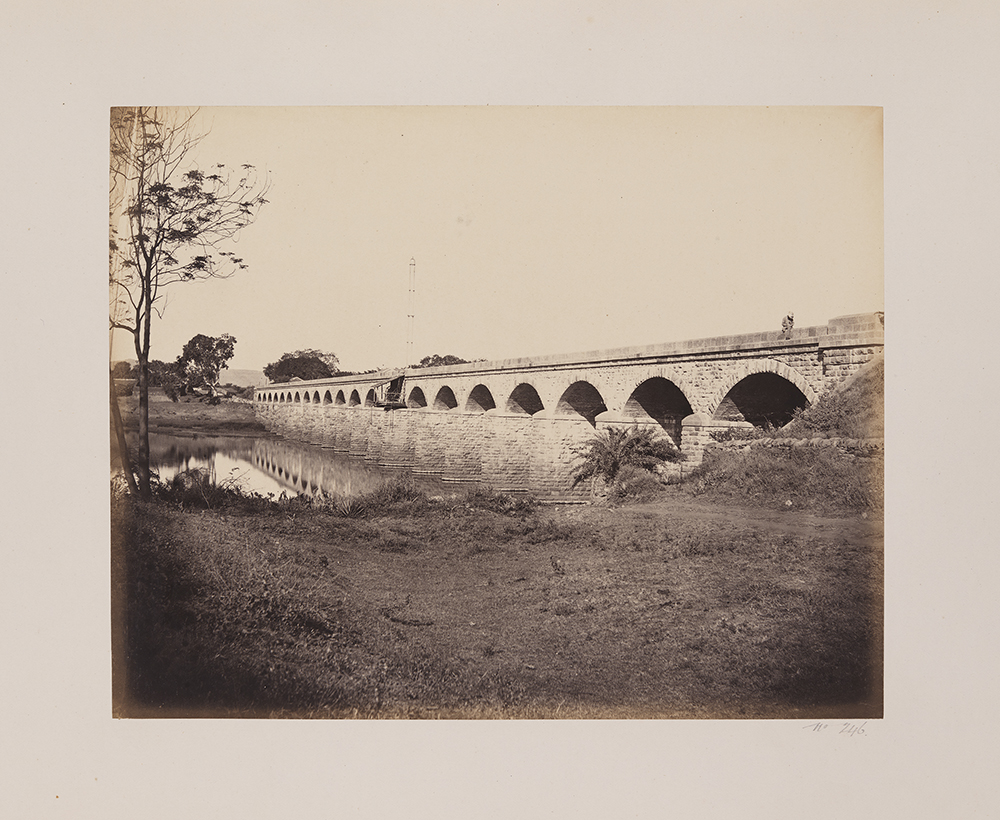
No. 246 — “Railroad Bridge”
The catalogue preserves the handwritten captions attached to the original photographs.
Photograph No. 246 is particularly important to the story of Sangam. The photograph, captioned simply “Railroad Bridge”, can be identified as the Old Sangam Railway Bridge by comparison with the surviving structure and its geographical setting.

The identification is also consistent with the sequence of Johnson’s railway photographs and with the fact that the Khandala–Poona railway had only recently been completed.
There is something appropriate about the anonymous caption. In the 1850s, the bridge did not yet have the heritage significance it carries today. To Johnson, it was simply a railway bridge — one of the new structures that were transforming western India. Yet that anonymous photograph may preserve one of the earliest visual records of the bridge.
Almost sixty years later
By 1917, the structure had acquired the name by which it would become better known. A Raphael Tuck & Sons postcard published that year is titled:
“The Sangum Bridge. Poona.”
The date is significant. This was not yet a retired railway structure. The bridge was still carrying railway traffic.
Between Johnson’s nineteenth-century photograph and the 1917 postcard lie almost sixty years of railway history. During that time, the bridge witnessed the transformation of the Great Indian Peninsula Railway from a pioneering enterprise into one of the most important railway systems in western India.
The bridge survived that transformation.
The railway grew around it
When the Sangam bridge was built, the railway was still in its infancy. The locomotives were small by later standards. Traffic was modest. The railway itself represented an entirely new technology. Over the following decades, everything changed.
Poona developed into an increasingly important railway centre. Lines extended eastwards towards Daund and beyond, while the railway network towards southern Maharashtra expanded. The opening of the Poona–Nira metre-gauge line in 1886 further strengthened the city’s position as a railway junction.
The Bombay–Poona route itself became one of the most important railway corridors in western India. The bridge, originally designed for the railway of the 1850s, was now part of a railway carrying traffic on a completely different scale. By the 1920s, the transformation was accelerating.
The railway was being prepared for heavier traffic, more powerful locomotives, improved capacity and electric traction. Bridge renewals and strengthening formed part of the wider modernisation programme of the GIPR.
The railway approaching Sangam in the 1920s was therefore very different from the railway that had crossed the bridge in 1858.
When the railway moved on

A new railway bridge was constructed immediately alongside the old structure. A remarkable archival photograph survives showing the new girder bridge and the old masonry bridge, with the railway being transferred from one to the other.
The new railway bridge was completed in 1926, and railway traffic was transferred from the old bridge during 1926–27. The old bridge was not demolished. The railway simply moved across to the new structure. The old masonry bridge then acquired a second life as a road bridge.
This is an important part of the story because it cautions against a simple explanation that the old bridge was abandoned because it had become unsafe. We have not yet found a contemporary engineering document that gives the precise bridge-specific reason for its replacement.
What we do know is that the replacement occurred during a period of major modernisation of the Bombay–Poona railway, when traffic was increasing, heavier and more powerful locomotives were being introduced, bridge renewals were being undertaken and the route was being prepared for electric traction.
The exact reason for replacing Sangam therefore remains an interesting question for future archival research.
Two bridges, two railway ages
There is something particularly appropriate about the fact that the old bridge was eventually replaced by a girder structure. The first bridge belonged to the age of masonry. Its arches carried the railway over the Mutha using the materials and construction techniques of the pioneering railway era.
The new bridge belonged to the age of steel, heavier trains and electrification. The change was not merely the replacement of one bridge by another. It represented the transformation of the railway itself. The old bridge had carried the first generation of trains into Poona. The railway had eventually evolved beyond the requirements of the structure. But the bridge itself did not disappear. It simply stepped aside.
A second life
After the railway moved to the new bridge, the old structure continued as a road bridge and became part of the everyday landscape of Pune. Then, in 1961, it faced another great test.
The Panshet flood devastated large parts of Pune and damaged several of the city’s historic bridges. The Sangam bridge was severely affected, and two of its arches had to be rebuilt. The restoration took more than a year.
The bridge that stands today is therefore not entirely the bridge of 1857. It is a palimpsest of more than a century and a half of history:
1857 — railway masonry
1858 — railway reaches Poona
1926–27 — railway moves to the new bridge
After 1927 — old bridge becomes a road crossing
1961 — flood damage and reconstruction
Later decades — further modifications and widening
Yet beneath these changes, the nineteenth-century masonry remains.
The bridge that carried the railway into Poona
There is a temptation, when looking at old railway structures, to think of them simply as monuments frozen in time. The Old Sangam Railway Bridge is more interesting than that.
It was built as part of the great push of the Great Indian Peninsula Railway towards Poona. It carried the first generation of locomotives into the city. It witnessed the growth of Poona into an important railway centre. It survived almost seventy years of railway service. And when the railway had evolved beyond the requirements of the structure, it did not disappear. It simply stepped aside. The trains moved onto the new bridge. The old arches remained.
Today, a person crossing the bridge by road is travelling over a structure that was already standing when the railway first entered Poona in 1858. That makes the Old Sangam Railway Bridge more than an old bridge.
It is one of the surviving physical links to the moment when the railway first entered Poona. And perhaps that is the most fitting way to remember it — not merely as a surviving nineteenth-century structure, but as the bridge that carried the railway into Poona.
References and further reading
Bombay Government, Report on the Administration of Public Affairs in the Bombay Presidency, 1856–57 — contemporary account of the Khandala–Poona railway works and the two major viaducts.
Bombay Government, Annual Report on the Administration of the Bombay Presidency, 1858–59 — records the opening of the Khandala–Poona section to public traffic on 14 June 1858.
William Johnson, Photographs of Western India, Volume III — DeGolyer Library, Southern Methodist University. Photograph No. 246, “Railroad Bridge”, is identified here as the Old Sangam Railway Bridge.
Gazetteer of the Bombay Presidency / Poona District Gazetteer — useful for distinguishing the Wellesley road bridge from the old and new railway bridges.
FIBI — The Sangum Bridge, Poona — 1917 postcard.

IRFCA Heritage Collection — photographs documenting the old and new railway bridges and the transfer of railway traffic in the 1926–27 period.
Indian Express — historical account of the 1961 Panshet flood and the subsequent reconstruction of two arches of the Sangam Bridge.
Leave a Reply