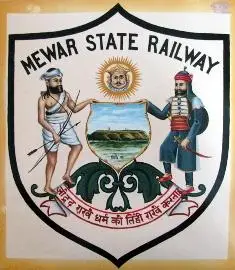
Among the many princely state railways that once criss-crossed the Indian subcontinent, the Mewar State Railway possessed one of the most distinctive identities. Long before corporate branding became an integral part of rail transport, the rulers of Mewar understood the importance of symbolism. Their railway emblem was far more than a decorative crest—it was a visual declaration of sovereignty, heritage, and the enduring legacy of the House of Sisodia.
Today, while locomotives bearing the emblem have long disappeared and the Mewar State Railway itself has become part of Indian Railways, its symbol remains an important reminder of how princely states sought to project their identity through modern infrastructure.
Railways in the Kingdom of Mewar
The princely state of Mewar, with its capital at Udaipur, was among the most respected Rajput kingdoms in India. Ruled by the Sisodia dynasty, the state enjoyed a reputation for courage, independence and resistance against foreign domination.
Recognising the transformative power of railways in the late nineteenth century, Maharana Fateh Singh initiated the development of a state-owned railway network. Construction began in the 1890s, and the first sections opened towards the end of the decade. The railway connected Udaipur with Chittorgarh and eventually linked the kingdom with the broader Rajputana-Malwa railway system.
Unlike many princely states that simply relied upon British-operated railways, Mewar consciously developed its own railway administration, complete with its own insignia and visual identity.
The Origin of the Railway Emblem
The emblem adopted by the Mewar State Railway was derived directly from the Royal Coat of Arms of the Kingdom of Mewar.
Rather than creating an entirely new logo, the railway administration chose to employ the state’s traditional royal symbolism. This decision reflected a deliberate message:
- the railway belonged to the Maharana,
- it served the people of Mewar,
- and it represented the authority of one of India’s oldest ruling dynasties.
This was common among princely railways, where railway insignia often mirrored royal coats of arms, reinforcing the idea that the railway was an extension of the ruler’s governance.

The Design of the Emblem
Although variations existed over time, the emblem generally incorporated several characteristic elements of the Mewar royal arms.
The Sun Symbol
The most prominent feature was the radiant Sun (Surya).
The Sisodia rulers claimed descent from the legendary Suryavanshi (Solar) Dynasty, tracing their lineage to Lord Rama through the Ikshvaku dynasty.
For centuries, the Sun had served as the principal emblem of the House of Mewar. It represented:
- divine legitimacy,
- continuity of rule,
- courage,
- truth,
- and eternal sovereignty.
Its inclusion on railway locomotives symbolised that every train operated under the authority and protection of the Maharana.
Rajput Martial Tradition
Many versions of the royal arms also incorporated martial imagery associated with Rajput culture.
These included:
- shields,
- spears,
- swords,
- ceremonial weapons,
- royal banners,
- and occasionally traditional Rajput supporters.
These elements reminded viewers that the rulers of Mewar were celebrated not merely as administrators but as defenders of their homeland.
The railway thus became a symbol not only of technological progress but also of Rajput honour.
Royal Crown and Crest
The crest often carried the royal crown or ceremonial insignia representing the sovereignty of the Maharana.
Unlike British imperial crowns, these reflected indigenous Rajput kingship, emphasising that Mewar remained an internally autonomous princely state despite British paramountcy.

Why Was Such an Emblem Necessary?
During the late nineteenth century, railways were among the most visible symbols of modern governance.
Every locomotive travelling through villages and towns acted as a moving ambassador of the state.
The emblem therefore served several purposes.
Assertion of Sovereignty
Although Mewar accepted British suzerainty, it retained considerable internal autonomy. Displaying the royal arms on railway property reminded passengers and officials alike that the railway belonged to the Maharana rather than directly to the British Government.
Public Confidence
For local residents, the familiar royal symbol inspired trust. The emblem reassured people that the railway was an institution backed by the state and operated under royal patronage.
Administrative Identity
The emblem distinguished Mewar State Railway from neighbouring systems such as:
- Rajputana-Malwa Railway,
- Bombay, Baroda and Central India Railway,
- Jaipur State Railway,
- Jodhpur Railway.
Each princely railway sought its own visual identity, and the Mewar emblem provided immediate recognition.
The Symbol on Rolling Stock
Historical photographs show the emblem displayed on:
- steam locomotives,
- carriage sides,
- station name boards,
- official stationery,
- administrative documents,
- engineering equipment,
- railway seals,
- ceremonial publications.
The royal insignia functioned much like today’s railway logos. Passengers could immediately identify a train belonging to the Mewar State Railway.
A Reflection of Rajput Values
Perhaps the most remarkable aspect of the emblem was how successfully it combined tradition with modernity.
The railway represented industrial technology imported from Europe.
The emblem represented centuries-old Rajput civilisation.
Together they conveyed an important message:
Modern progress need not come at the cost of cultural identity.
This philosophy became one of the defining characteristics of many princely state railways.
Comparison with Other Princely Railway Symbols
Several princely railways adopted heraldic devices based on their ruling houses, but the Mewar emblem stood apart because of its deep historical lineage. Unlike newer states that adopted European-style heraldry, the Mewar emblem drew upon symbols that had represented the Sisodia dynasty for centuries. The radiant Sun was instantly recognisable and deeply rooted in Rajput tradition, giving the railway an identity that was both unmistakable and historically authentic.
The End of the Mewar State Railway
Following Indian Independence in 1947 and the integration of princely states, the Mewar State Railway was gradually merged into the national railway system.
Its separate administration disappeared, and the royal insignia was replaced by the emblems of the newly formed Indian Railways.
Yet the memory of the emblem survives in:
- preserved photographs,
- archival documents,
- railway correspondence,
- collectors’ memorabilia,
- and the heritage of Rajasthan’s railway history.
Legacy: More Than a Logo
The emblem of the Mewar State Railway was much more than a decorative badge. It embodied the values of a kingdom that balanced ancient traditions with the demands of modern governance. By adopting the royal arms, the railway projected continuity, legitimacy and regional pride, distinguishing itself from neighbouring systems and strengthening public confidence in a transformative new mode of transport.
Today, the emblem stands as a reminder that railways were not merely engineering achievements; they were also powerful expressions of identity. For the people of Mewar, every locomotive carrying the radiant Sun symbol represented the enduring spirit of the Sisodia dynasty—a dynasty that embraced the future without relinquishing its heritage.
The emblem helped shape the Mewar railway’s identity in several lasting ways:
- It reinforced royal ownership, making the railway a visible extension of the Maharana’s administration.
- It cultivated public trust, as the familiar solar emblem conveyed continuity, stability and state patronage.
- It distinguished the railway from neighbouring systems, giving Mewar a unique visual identity within the diverse network of princely and British-operated railways.
- It united employees under a shared symbol, fostering loyalty and pride in serving a railway associated with one of India’s oldest royal houses.
- It preserved cultural continuity, demonstrating that technological progress and Rajput heritage could coexist harmoniously.
In an era before standardised corporate branding, the Mewar State Railway’s emblem achieved what modern logos aspire to do: it instantly communicated the values, history and aspirations of the institution it represented. More than a century later, it remains one of the most evocative symbols in the story of India’s princely state railways.
Leave a Reply