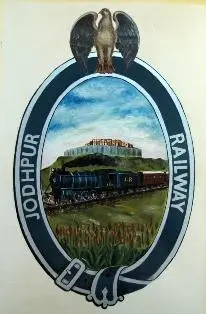
Among the many princely state railways that flourished during British India, the Jodhpur State Railway (JSR) possessed one of the most distinctive and artistically designed emblems. Unlike many railway companies that relied on simple initials or monograms, the Jodhpur State Railway adopted an emblem that narrated a story through symbolism. Every element of the design reflected the pride of the Kingdom of Marwar, its royal patronage and its embrace of modern railway technology.
The emblem was far more than a decorative badge. It represented the identity of the railway, its association with the ruling Rathore dynasty and its role in transforming the economy and society of western Rajasthan. Even today, it remains one of the finest examples of railway heraldry created by any princely state in India.
The Birth of the Jodhpur State Railway
The Jodhpur State Railway was established in 1885 during the reign of Maharaja Jaswant Singh II with the objective of connecting the desert kingdom of Marwar to the rapidly expanding railway network of British India. Prior to the arrival of the railway, trade across the region depended largely upon camel caravans and bullock carts, making transportation slow, costly and uncertain.
The construction of the railway marked the beginning of a new era of transportation. It connected important commercial centres, facilitated the movement of salt, wool, livestock and agricultural produce, and transformed Jodhpur into an important railway centres of north-western India. As the railway expanded into one of the largest princely state railway systems, it naturally required a distinctive identity that reflected both its royal ownership and its growing importance. The emblem fulfilled this purpose perfectly.
The Emblem
The emblem of the Jodhpur State Railway is an artistic composition in which every element has been carefully chosen to communicate the character and aspirations of the railway.

The Royal Vulture – Guardian of the Railway
Crowning the emblem is a majestic vulture with fully spread wings.
The bird closely resembles the heraldic bird associated with the Royal House of Jodhpur (Marwar). In Rajput tradition, birds of prey symbolise vigilance, courage, protection and sovereign authority. Positioned above the entire composition, the vulture signifies that the railway functioned under the patronage and protection of the Maharaja.
Its elevated position conveys authority and confidence, reminding the viewer that the railway was not merely a commercial enterprise but a prestigious institution belonging to the princely state.
The Oval Frame – A Distinct Railway Identity
The central painting is enclosed within a bold dark blue oval carrying the inscription “JODHPUR RAILWAY.”
The oval frame serves as the official identity of the railway. Its unbroken circular form symbolises continuity and the railway network that united the scattered towns and settlements of Marwar. The prominent lettering leaves no doubt about the ownership of the railway and establishes a distinct institutional identity.
Unlike elaborate European heraldic shields, the oval design is simple, elegant and immediately recognisable.
The Steam Locomotive – The Symbol of Progress
At the heart of the emblem is a beautifully illustrated steam locomotive pulling a passenger train across the countryside. The locomotive represents the arrival of industrial technology in the desert kingdom. It symbolises progress, engineering excellence and the determination of the rulers of Jodhpur to modernise their state.
The artist deliberately depicts the locomotive moving confidently through the landscape, portraying the railway as an engine of development that brought commerce, communication and prosperity to regions that had previously depended upon traditional means of transport.
Mehrangarh Fort – The Eternal Symbol of Marwar
Dominating the background is the magnificent Mehrangarh Fort, one of India’s greatest hill forts and the historic seat of the Rathore rulers. Its inclusion immediately establishes the identity of the railway. Mehrangarh is inseparable from Jodhpur itself and serves as the ultimate symbol of the kingdom’s history, strength and royal authority.
The juxtaposition of the steam locomotive with the ancient fort conveys a powerful message. The railway represents modernity, while Mehrangarh represents tradition. Together they demonstrate that the Kingdom of Jodhpur embraced technological progress without losing sight of its glorious heritage.
Few railway emblems in India capture this balance between history and modernisation as effectively.
The Landscape – Conquering the Desert
The foreground portrays the natural landscape through which the train passes. This scene likely symbolises the difficult terrain of Marwar and the remarkable engineering achievement of constructing railway lines across the arid plains of western Rajasthan. The railway brought mobility, trade and opportunity to a region where transport had traditionally depended upon camel caravans. The landscape therefore represents not merely geography but the transformation of the desert through the power of rail transport.
More Than a Railway Logo
The Jodhpur State Railway emblem is remarkable because it tells a complete story rather than simply identifying the organisation.
The vulture represents royal authority and protection.
The steam locomotive represents technological progress and economic development.
The Mehrangarh Fort represents the heritage, pride and identity of the Kingdom of Marwar.
The desert landscape represents the region whose destiny was transformed by the railway.
Together these elements communicate the message that the railway was an institution rooted in royal tradition while looking confidently towards the future.
Unlike many railway emblems of the nineteenth century that consisted merely of initials or coats of arms, the Jodhpur State Railway adopted an artistic narrative that immediately conveyed its identity to passengers, employees and visitors alike.
Historical Significance
The Jodhpur State Railway became one of the most successful princely state railways in India. Its extensive metre-gauge network played a vital role in transporting salt, wool, livestock, sandstone and agricultural produce while also serving important strategic functions along India’s north-western frontier.
The emblem reflected these achievements by presenting the railway as a symbol of progress under royal leadership. It became an enduring representation of the partnership between the Rathore rulers and the railway that helped modernise their kingdom.
Legacy
Following the integration of the princely states after Independence, the Jodhpur State Railway became part of the Western Railway of Indian Railways. Although its independent administrative identity came to an end, its emblem continues to survive as a beautiful examples of railway heraldry in India.
Today, the emblem remains a visual reminder of a railway that successfully combined royal patronage, regional identity and technological progress into a single design. More than a century after it was first created, it continues to tell the story of a desert kingdom that embraced the railway as a symbol of modernity while proudly preserving its rich heritage.
Leave a Reply