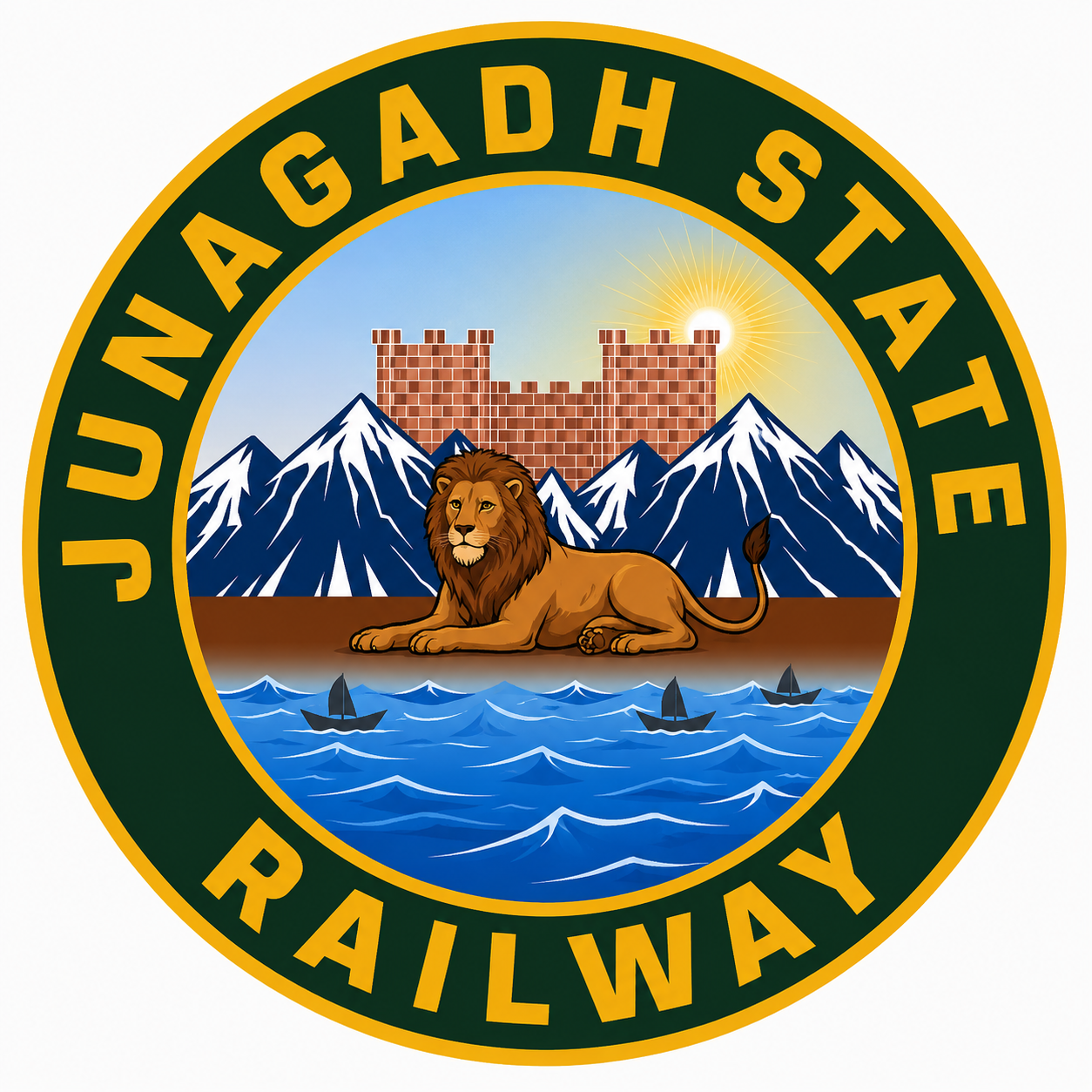
Among the many princely state railway emblems of pre-Independence India, the emblem of the Junagadh State Railway is perhaps one of the most distinctive. Unlike many railway insignia that prominently feature locomotives or heraldic crests, the Junagadh emblem tells the story of the state itself. Every element—the lion, the fort, the mountains, the sea and the tiny sailing boats—was carefully chosen to represent the geographical, political and economic identity of the princely state. Rather than glorifying the railway alone, the emblem presents the railway as a lifeline connecting the state’s natural wealth, maritime trade and royal authority.
The Origins of the Junagadh State Railway
The Junagadh State Railway was established by the Nawabs of Junagadh during the late nineteenth century as part of the rapid expansion of railways across Kathiawar (Saurashtra). The first sections opened in the 1880s and gradually linked Junagadh with Veraval, Jetalsar and neighbouring princely states. These connections integrated the state into the wider railway network of western India, facilitating passenger movement, trade and pilgrimage while strengthening Junagadh’s economy.
Unlike the larger railway companies operated directly by the British Government, the Junagadh State Railway remained a symbol of the Nawab’s administration and reflected the state’s independent identity within British India.
The Emblem

At first glance, the emblem appears simple, but every component carries symbolic significance.
The outer circular band, finished in deep green with golden lettering proclaiming “JUNAGADH STATE RAILWAY,” represents continuity, unity and permanence. The circular form was a popular design among princely state railway logos because it conveyed authority while providing an instantly recognisable corporate identity.
At the centre of the emblem lies a majestic lion resting calmly upon a strip of land. This is undoubtedly the most important feature of the logo. Junagadh was—and continues to be—the home of the Asiatic Lion, whose last natural habitat survives in the Gir forests. The lion symbolises courage, sovereignty and the unique natural heritage of the state. Rather than depicting the animal in an aggressive posture, the artist portrays it in repose, conveying confidence and regal authority rather than conquest.
Behind the lion rises a fortified structure, representing the historic Uparkot Fort, one of India’s oldest surviving fortifications and a defining landmark of Junagadh. The fort signifies the antiquity, resilience and military strength of the princely state.
Flanking the fort are towering snow-clad mountains. Although Junagadh itself does not possess Himalayan peaks, these stylised mountains are likely intended to represent the rugged Girnar Hills, one of western India’s most sacred mountain ranges. The artist appears to have used dramatic alpine forms to emphasise grandeur and permanence rather than geographical accuracy.
A radiant sun rising behind the fort symbolises hope, prosperity and enlightenment. Across Indian heraldic traditions, the rising sun represents progress and the dawn of a new era—an appropriate message for a railway that was transforming transportation and commerce.
The Sea and Three Boats
Perhaps the most intriguing aspect of the emblem is the depiction of the blue sea in the foreground, upon which three small sailing boats can be seen.
These boats are not decorative additions. They are a direct reference to Junagadh’s long maritime tradition. The state controlled important ports such as Veraval, one of western India’s oldest fishing and trading harbours. For centuries, merchants from this coast traded with Arabia, East Africa and the Persian Gulf.
The inclusion of three boats symbolises maritime commerce, prosperity and Junagadh’s historic connection with the Arabian Sea. Their presence also reminds the viewer that the railway was not an isolated transport system—it was designed to connect inland markets with coastal ports, enabling goods and passengers to move efficiently between sea and rail.
In this sense, the boats complete the story told by the emblem: the railway united forests, hills, forts and ports into a single economic network.
Why the Emblem is Unique
Most princely railway emblems either displayed royal coats of arms or locomotives. The Junagadh State Railway emblem is unusual because it contains neither. Instead, it presents a visual narrative of the state itself.
The lion represents wildlife and sovereignty.
The fort represents history and political authority.
The Girnar hills symbolise geography and spirituality.
The sea and boats celebrate maritime trade.
Together these elements communicate the identity of Junagadh more effectively than any locomotive could.
A Lasting Legacy
Following Independence, the Junagadh State Railway was merged into the railway systems of Saurashtra and eventually became part of Western Railway under Indian Railways. While the railway itself disappeared as an independent entity, its emblem remains an important reminder of how princely states expressed their identity through railway symbolism.
Today, the Junagadh State Railway emblem stands as more than a railway logo. It is a miniature portrait of an entire kingdom—celebrating its wildlife, historic fortifications, sacred landscape and maritime traditions. It reflects an era when railways were not merely transport networks but proud ambassadors of the states they served, carrying their heritage as prominently as their passengers and freight.
Leave a Reply